


The Ghost of the Deep: Diving with Thresher Sharks in the Philippines
In the world of shark diving, there are “encounters,” and then there are “events.”
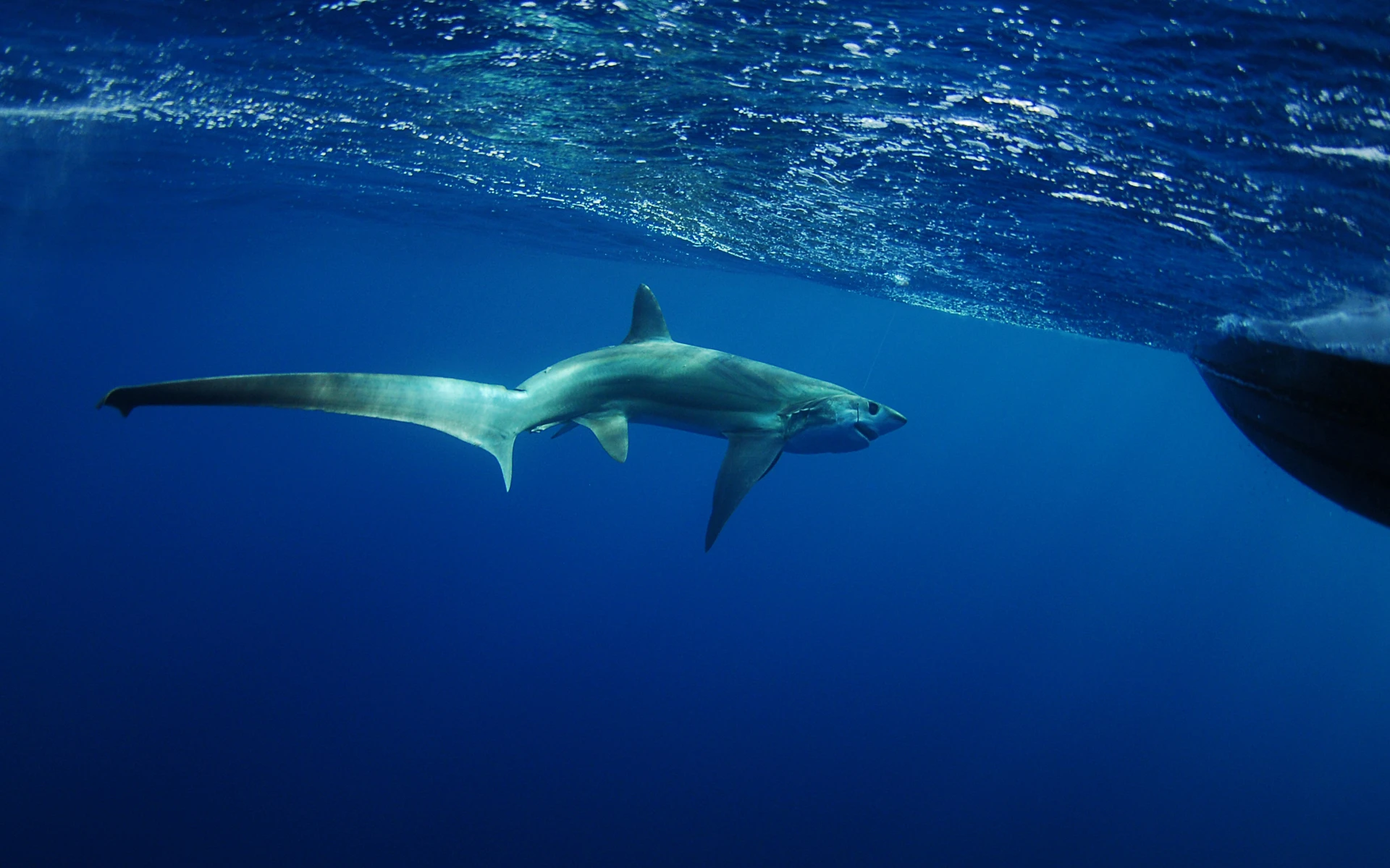
Seeing a Thresher Shark in the wild is an event. With a scythe-like caudal fin (tail) that can be as long as its entire body and large, dark eyes designed for the pitch-black depths of the mesopelagic zone, the Thresher Shark looks like something straight out of a biological fantasy novel. This is one of the bucket list events for people interested in diving in the Philippines.
For decades, these sharks were a myth to recreational divers—shadowy inhabitants of the deep ocean that were rarely seen alive. That changed when a sunken island called Monad Shoal, just a short boat ride from Malapascua in the Philippines, was discovered to be a natural “cleaning station” for these elusive predators.
The Science of the Scythe: Why the Tail?
The most striking feature of the Thresher Shark is, of course, its tail. This isn’t just for show; it is one of the most specialized hunting tools in the marine world.
Unlike most sharks that bite their prey, the Thresher Shark uses its tail as a whip. It swims toward a school of small fish (like sardines or mackerel), brakes suddenly with its large pectoral fins, and whips its tail over its head at speeds of up to 50 mph (80 kph). The resulting shockwave and physical strike stun or kill multiple fish at once, allowing the shark to feed at its leisure.
The Malapascua Connection: Monad Shoal and Kimud Shoal
So, why do these deep-water sharks come up to depths where scuba divers can see them here? The answer is hygiene.
Thresher Sharks spend most of their time at depths of 200 to 500 meters, where it is cold and dark. However, they are plagued by parasites. Monad Shoal is a seamount that rises from the depths to about 20 meters below the surface. This plateau is home to several species of “cleaner wrasse”—tiny fish that act as a mobile car wash, picking parasites and dead skin off the sharks.
The Early Bird Gets the Shark
To see them, you have to be an early riser. The “classic” Thresher Shark dive in Malapascua typically begins with a 4:30 AM or 5:00 AM boat departure. You want to be on the plateau of Monad Shoal just as the first rays of sunlight hit the water. This is when the sharks are most active, transitioning from their nighttime hunting in the deep to their morning cleaning session.
The New Evolution: Kimud Shoal
In recent years, the shark sightings have shifted slightly toward Kimud Shoal, a nearby sunken island. Here, the encounters are often shallower and more dramatic, with the sharks sometimes circling divers in just 12 to 15 meters of water. This has opened up the experience to Open Water divers, though Advanced Open Water is still highly recommended to truly enjoy the deeper cleaning stations.
What to Expect During the Dive
A Thresher Shark dive is a “sit and wait” experience.
-
The Descent: You descend onto a sandy ledge or behind a low coral wall that acts as an “observation deck.” This is designed to give the sharks space and ensure they don’t feel crowded.
-
The Arrival: You’ll be looking out into the “blue,” where the plateau drops off into the abyss. Suddenly, a silver shimmer appears. The movement of a Thresher Shark is unmistakable—it’s a sinuous, whip-like motion that is incredibly graceful.
-
The Interaction: As the cleaner wrasse do their work, the shark will often circle the station repeatedly. Because they have large eyes adapted for low light, they are sensitive to movement and flashes. If the group remains still and quiet, the sharks will often pass within a few meters of the divers.
Photography Tips for Thresher Sharks
Capturing a Thresher Shark on camera is a challenge due to the low light of the early morning and the sharks’ reflective silver skin.
-
No Strobes: Most dive shops in Malapascua prohibit the use of strobes on the Thresher Shark dives. The bright flashes can spook the sharks and disrupt their cleaning behavior. High ISO settings and a steady hand are your best friends here.
-
White Balance: Since you are diving in the early morning blue light, manually setting your white balance or using a “cloudy” preset can help bring back some of the natural silver tones of the shark.
-
Video is King: Because the Thresher’s tail is its most iconic feature, video often captures the majesty of its movement better than a still photo ever could.
 Conservation and the Future
The Philippines has made massive strides in shark conservation. In 1897, the Thresher Shark was officially protected across the entire country, making it illegal to catch, sell, or transport them. Malapascua is a shining example of how “Shark Tourism” can provide a sustainable economic alternative to fishing, ensuring that these incredible animals are worth more alive than dead.
Is Malapascua on Your List?
Whether you are coming for the “Adrenaline” of the sharks or the “Zen” of the nearby Gato Island (famous for its sea snakes and tunnels), Malapascua offers a diving experience unlike any other in the Philippines. It is a place where the legends of the deep come into the light, even if only for a few minutes at sunrise.
